
What Is a Personalized Rehabilitation Care Plan and Why Does It Matter?
September 25, 2026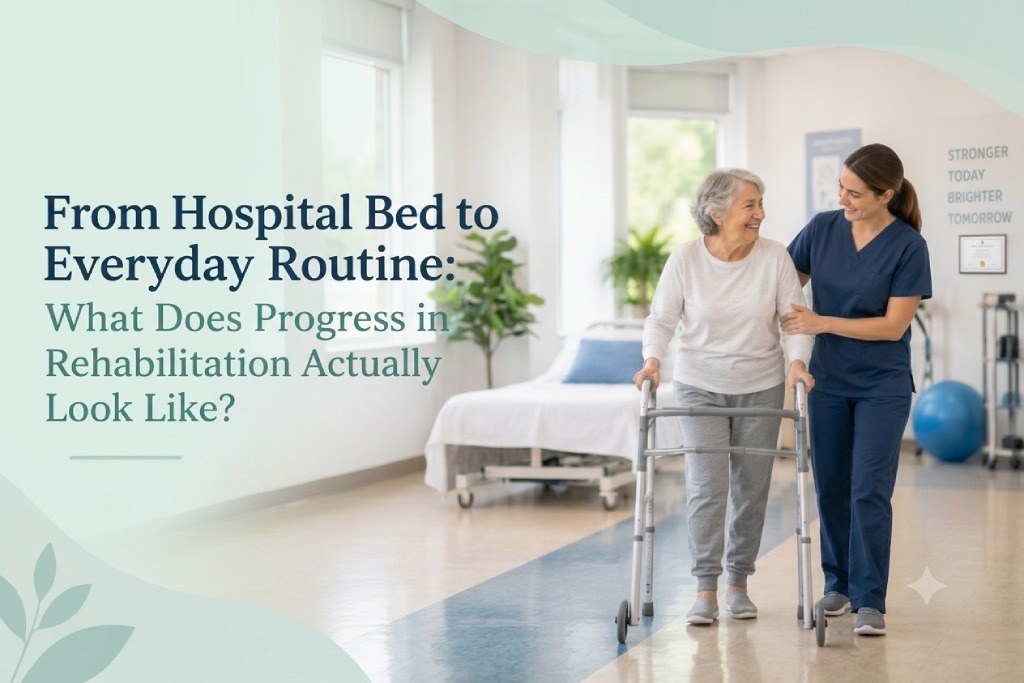
Recovery rarely arrives all at once. More often, it shows up in small, everyday wins that add up to greater independence.
When someone enters rehabilitation after a hospital stay, families naturally want to know one thing: Are they getting better?
The answer isn’t always as simple as watching someone walk farther each day. Recovery after surgery, illness, injury, or an extended hospitalization often happens in small increments. Progress might mean getting out of bed with less assistance, standing long enough to brush your teeth, walking safely to the bathroom, or having enough endurance to get dressed without becoming exhausted.
These everyday achievements may not sound dramatic, but they can represent important steps toward greater independence.
For people receiving short-term rehab in New Bern, NC, rehabilitation is often about rebuilding the skills and confidence needed for daily life. Understanding what progress can actually look like helps residents and families appreciate those smaller milestones while keeping longer-term goals in sight.
Jump To Section
After the Hospital
Why Can Everyday Activities Become Difficult After Hospitalization?
Even a relatively short hospital stay can affect strength, mobility, balance, and endurance, particularly for older adults.
Illness itself can be exhausting, and spending more time in bed or being less active than usual can contribute to deconditioning. Many people begin rehabilitation while also navigating:
Surgery, which may add pain, temporary movement restrictions, or precautions that make certain activities more difficult
New medications that can affect how a person feels day to day
Changes in appetite that influence energy and strength
Ongoing medical conditions that need to be managed alongside recovery
As a result, a person who was walking independently before hospitalization may suddenly need assistance standing from a chair. Someone who managed their own morning routine may struggle to get dressed or safely step into the shower.
That change can be frustrating for residents and concerning for families, but it also gives the rehabilitation team a starting point for setting individualized goals.
The Starting Point
Progress Starts With Knowing Where You Are
Before the rehabilitation team can measure improvement, they need to understand the resident’s current abilities.
During the early stages of nursing rehabilitation in New Bern, assessments may look at the following areas, depending on the resident’s condition:
Strength, balance, and walking
Transfers and endurance
Activities of daily living
Communication and cognition
Swallowing
The team also considers what the person could do before hospitalization.
For example, there is a significant difference between a resident who previously walked several blocks independently and someone who already used a walker and needed help with certain daily activities. Rehabilitation goals should reflect the individual rather than comparing everyone to the same standard.
Once that starting point is established, progress becomes easier to recognize.
Early Milestones
Progress May Begin With Simply Getting Out of Bed
For someone who has experienced significant weakness or a lengthy hospitalization, sitting on the edge of the bed or transferring safely to a chair can be an important accomplishment.
Early physical therapy may focus on basic movements that are necessary before more advanced mobility can occur, such as:
Repositioning and sitting upright
Standing
Transferring between surfaces
Taking the first few supported steps
As strength and confidence improve, the amount of assistance needed may decrease. Over time, that change often looks like this:
Those changes matter because transfers are part of nearly every daily routine, from getting out of bed in the morning to using the bathroom or sitting down for a meal.
Mobility
Walking Farther Isn’t the Only Sign of Mobility Progress
Walking is often one of the most visible parts of rehabilitation, so families may naturally use distance as their main measure of improvement. But mobility progress involves much more than how far someone can walk.
A physical therapist may also be working with a resident on:
Balance and posture
Turning and navigating obstacles
Using an assistive device
Controlling movements when sitting down and standing up
Someone may initially be able to walk a certain distance but do so unsteadily or with substantial assistance. Over time, they might cover a similar distance with better balance, less assistance, or greater confidence.
That is progress, too. The ultimate goal isn’t simply to accumulate steps. It’s to help the resident move as safely and functionally as possible based on their individual abilities.
Daily Living
Everyday Tasks Are an Important Measure of Recovery
Imagine returning home able to walk down the hallway but unable to get dressed, use the bathroom, or prepare for bed without significant assistance. Mobility alone doesn’t tell the whole story of independence.
That’s where occupational therapy can become an important part of rehabilitation. Occupational therapists may help residents practice activities of daily living such as dressing, bathing, grooming, toileting, and other routines. Therapy may also introduce adaptive techniques or equipment when appropriate.
Progress in this area could look like:
Fastening clothing more easily
Completing grooming tasks while standing at the sink
Needing less assistance with bathing
These accomplishments directly affect how much support someone may need when returning home, making them valuable measures of rehabilitation progress.
Endurance
Endurance Often Improves Little by Little
One of the less obvious challenges after hospitalization is fatigue.
A resident may have the strength to stand or walk but become tired much faster than they did before becoming ill. Even completing a morning routine can feel like a workout.
Rehabilitation may gradually increase activity based on the resident’s condition and tolerance. Early in the stay, someone may need frequent rest breaks during therapy or daily activities. As endurance improves, they may be able to participate longer, walk farther, or complete several activities without needing as much time to recover.
Families may notice that their loved one:
Stays out of bed longer
Participates more in daily routines
Simply seems less exhausted after activity
Those changes can be meaningful signs that recovery is moving forward.
Emotional Recovery
Confidence Is Part of Progress, Too
Recovery isn’t entirely physical.
A fall, surgery, or serious illness can leave someone afraid to move the way they once did. A resident may worry about falling again, experiencing pain, or being unable to complete a task without help.
Therapy provides opportunities to practice movements in a supportive setting and learn safer techniques. As residents repeat these skills and experience success, confidence may begin to return. Someone who was initially hesitant to stand may start initiating transfers more readily. A resident who was afraid to use a walker may become more comfortable moving through the facility.
Greater confidence doesn’t mean ignoring safety precautions. Instead, it can help residents participate more actively in recovery while understanding how to work within their current abilities.
The Bigger Picture
Some Days Will Be Better Than Others
One of the most important things families can understand about rehabilitation is that recovery isn’t always a straight line.
A resident may have an excellent therapy session one day and feel more tired the next. Pain, sleep, medications, appetite, underlying health conditions, and the natural recovery process can all affect daily performance.
That doesn’t necessarily mean progress has stopped.
Rehabilitation teams look at changes over time rather than judging recovery based on a single difficult day. If a resident’s abilities consistently improve across days or weeks, that broader pattern may provide a better picture of progress.
Significant or unexpected changes should always be communicated to the healthcare team so they can determine whether further evaluation is needed.
Coordinated Care
Nursing Care and Rehabilitation Work Together
For many residents, recovery involves both medical and functional needs.
During nursing rehabilitation in New Bern, nurses and therapists can work together to support different parts of the recovery process:
Nursing professionals may address medication management, physician-directed care, wound needs, pain concerns, or changes in medical condition
Therapists focus on mobility and everyday function
These areas often overlap. If pain or another medical issue is limiting participation in therapy, nursing staff and therapists can communicate about the concern. Likewise, therapists may identify changes in function that should be shared with other members of the care team.
This coordinated approach can be particularly valuable for older adults managing multiple needs following hospitalization.
Looking Ahead
Progress Should Connect to Life After Rehabilitation
The most meaningful rehabilitation goals are often tied to what the resident needs to do next. If someone plans to return home, therapy may consider the environment they’re returning to:
Are there stairs?
Will the resident need to walk from the bedroom to a bathroom?
Can they safely get in and out of a chair?
Will family members be available to help?
As discharge approaches, progress may increasingly be measured against these practical needs.
For one resident, success may mean returning to independent walking. For another, using a walker safely may be the appropriate goal. Someone else may still require assistance but need less help than when rehabilitation began.
There isn’t one universal definition of successful rehabilitation. Progress should be considered in the context of each resident’s health, abilities, goals, and next care setting.
For Families
What Families Can Do to Encourage Progress
Family support can make the rehabilitation experience feel less overwhelming. A few simple ways to help:
Ask about goals. Talk with your loved one’s care team about current goals and what improvements they’re seeing. Instead of focusing only on when the resident will be discharged, ask what skills they’re working toward next.
Celebrate small accomplishments. Walking a few extra feet, standing with less assistance, getting dressed more independently, or making it through an activity without an extra rest break can all be worth recognizing.
Avoid comparisons. Age, medical history, type of illness or surgery, previous abilities, and many other factors can influence how quickly someone progresses, so try not to compare your loved one’s recovery with another resident’s.
The most useful comparison is often where the resident is today versus where they started.
Rehab at Bayview
Short-Term Rehabilitation at Bayview Nursing & Rehabilitation Center
At Bayview Nursing & Rehabilitation Center, rehabilitation is focused on the individual resident and the skills that matter to their recovery.
For families looking for short-term rehab in New Bern, NC, understanding that progress can take many forms can make the recovery process easier to navigate. Our care team may include:
Physical therapy to address strength, balance, and mobility
Occupational therapy to focus on everyday activities
Speech-language pathology to support residents with communication, cognition, or swallowing needs when appropriate
Within a rehabilitation facility in New Bern, NC, nursing and therapy professionals can work together to address both clinical and functional needs while helping residents prepare for their next transition.
Progress doesn’t always arrive as one dramatic breakthrough. More often, it appears in the small moments: standing a little steadier, walking with less assistance, completing part of a morning routine independently, or feeling confident enough to try something that seemed impossible a week earlier.
Those moments add up. For many residents, they’re the steps that gradually lead from a hospital bed back toward the routines and activities of everyday life.
Common Questions
Frequently Asked Questions About Short-Term Rehabilitation
What does short-term rehabilitation help with after a hospital stay?
Short-term rehab in New Bern, NC may help residents address weakness, reduced mobility, balance concerns, decreased endurance, and difficulty completing everyday activities after surgery, illness, injury, or hospitalization. The specific goals and services depend on the resident’s individual condition and needs.
How is progress measured during rehabilitation?
Progress can be measured in many ways, including changes in strength, walking, balance, endurance, transfers, ability to complete daily activities, and the amount of assistance a resident needs. Rehabilitation professionals consider the person’s starting abilities and individualized goals when evaluating improvement.
How long does short-term rehabilitation usually take?
There is no single rehabilitation timeline that applies to everyone. Length of stay can depend on the resident’s medical condition, previous level of independence, rehabilitation needs, progress, discharge environment, and available support. Insurance coverage and eligibility requirements may also affect the length of a covered stay.
What types of therapy might be provided at a rehabilitation facility in New Bern, NC?
Depending on individual needs, a rehabilitation facility in New Bern, NC may provide physical therapy, occupational therapy, and speech-language pathology. Physical therapy can address mobility and strength, occupational therapy focuses on everyday activities, and speech-language pathology may address communication, cognition, or swallowing concerns.
How can families tell if their loved one is making progress in nursing rehabilitation?
Look beyond dramatic changes. During nursing rehabilitation in New Bern, progress may include needing less help getting out of bed, walking more safely, improving balance, completing more self-care activities, tolerating longer periods of activity, or becoming more confident with movement. Asking the care team about current goals and changes since admission can also help families understand how recovery is progressing.
Let’s Talk About Your Loved One’s Recovery
Whether you’re planning ahead for a hospital discharge or exploring short-term rehab options right here in New Bern, our team is happy to answer your questions, explain how our therapy programs work, and show you around our warm, welcoming community.